How Cells Store Past Experiences – and Why the Body Remembers Previous Stressors
Following the typical waves of seasonal infections in the fall, we repeatedly encounter people who struggle to regain their previous levels of energy and resilience, even weeks or months after recovering from an illness.
Post-viral fatigue raises a fascinating question: Why does one person’s body recover completely, while another continues to experience persistent exhaustion, reduced physical and cognitive capacity, and heightened sensitivity to exertion?
One possible explanation may lie in the biological history of our cells. Scientific research suggests that previous physiological stressors can leave lasting imprints through epigenetic, immunological, and metabolic changes, potentially influencing how our bodies respond to future challenges.
Of particular interest is the concept of trained innate immunity, an emerging field of research that is increasingly being explored in the context of myalgic encephalomyelitis/chronic fatigue syndrome (ME/CFS). Whether these mechanisms actually contribute to the development or persistence of post-viral fatigue, however, remains an open scientific question.
In my latest Bioenergetic Insights article, I explore how cellular memory develops, the roles mitochondria and epigenetics may play in this process, and why our biological history could be an important factor in determining how we respond to therapeutic interventions.
Read the full article: Why Your Body Remembers – and What It Means for Therapy →
Marion Massafra-Schneider
When Biological Adaptability Is Compromised – What Therapeutic Options Are Available?
In the context of post-viral fatigue and ME/CFS, an important question arises: How are changes in energy metabolism, mitochondrial function, and autonomic regulation interconnected – and under what circumstances might specific physiological interventions be appropriate?
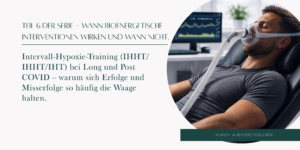
In our online educational module, “Intermittent Hypoxic Training (IHHT/IHT) for Chronic Fatigue and Post-COVID,” Dr. Egor Egorov, MD, examines the scientific foundations, potential mechanisms of action, and current research approaches involving hypoxic stimuli, mitochondrial regulation, and bioenergetic interventions.
Particular emphasis is placed on individual exercise and exertion tolerance, appropriate stimulus intensity and dosing, and safety considerations for individuals experiencing chronic exhaustion.
This is especially important because, in people with ME/CFS, additional physiological stress can trigger a significant worsening of symptoms, including post-exertional malaise (PEM). IHHT is not currently an established or sufficiently clinically validated treatment for ME/CFS.
Deepen your understanding of both the potential and the limitations of bioenergetic interventions.
Explore the online module with Dr. Egor Egorov, MD: