What actually happens inside our bodies when a biological stimulus triggers an adaptive response? And how can light, hypoxia, or mechanical vibrations influence the way our cells function?
Our bodies constantly respond to changes in the environment. We feel when we get cold, notice when we become short of breath, and experience how regular physical activity can improve our endurance and resilience. What we rarely notice, however, are the remarkably complex processes taking place inside our cells at the same time.
Our cells are far more than the tiny building blocks of the human body. They possess sophisticated sensing systems that allow them to detect changes in oxygen availability, energy status, chemical concentrations, and mechanical forces.
Imagine a cell as a highly organized city. It needs a reliable energy supply, functioning communication networks, and systems capable of responding when something goes wrong. If the energy supply changes, for example, operations must be adjusted, resources redistributed, and protective mechanisms activated when necessary.
Our cells operate according to a similar principle.
How an External Stimulus Becomes a Biological Response
In cell biology, this process is known as signal transduction. It describes how a cell detects a change in its environment and translates that information into a biological response.
One fascinating example is the cellular response to reduced oxygen availability. Through the hypoxia-inducible factor (HIF) system, cells can detect changes in oxygen availability and respond by modifying gene expression.
Other molecular systems, such as AMPK, monitor the cell’s energy status, while the Nrf2 signaling pathway helps regulate cellular defense mechanisms.
Photobiomodulation is another area of active research in this context. Specific wavelengths of red and near-infrared light can influence cellular processes associated with mitochondrial function and intracellular signaling.
The essential distinction is this: A biological stimulus is not the same as biological adaptation. It is the organism’s response that determines which changes actually occur.
This is precisely why we must distinguish between a scientifically established cellular mechanism and a clinically demonstrated health benefit.
What Does This Mean for Bioenergetic Interventions?
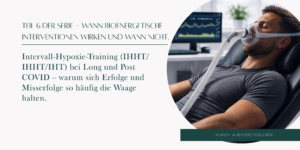
Whether we are discussing intermittent hypoxic training, photobiomodulation, or mechanical stimulation, these approaches differ in their physical properties and biological mechanisms. What they have in common is their potential to introduce stimuli that the body can detect and respond to.
But when does a short-term cellular response develop into a lasting adaptation? Which molecular signaling pathways are involved? And why doesn’t a measurable cellular reaction automatically translate into a beneficial health outcome?
In my latest Bioenergetic Insights article, we explore these questions at the cellular level, combining established scientific findings with accessible explanations and a balanced perspective on the possibilities and limitations of bioenergetic interventions.
→ Read the full article: “How Cells Translate Biological Stimuli Into Adaptation”
Marion Massafra-Schneider