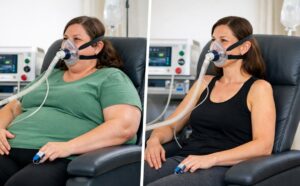
Why Controlled Oxygen Deprivation Helps the Nervous System
Hormesis: Small Stressors – Big Effects
Our body often responds to brief, non-dangerous stress impulses with positive adaptations.
Hypoxia – a temporarily reduced oxygen supply – is one such impulse.
These short phases of reduced oxygen activate specific protective programmes in the body, for example:
- repair and regeneration pathways
- formation of new mitochondria (more “cell power plants”) leading to significantly more energy
- new blood vessel growth and thus improved circulation
- reduced inflammatory activity
- stronger antioxidant defence systems
- neuroprotection, and much more
In short:
Well-dosed hypoxia is like a mini-workout for the cells – they become more resilient and healthier, which naturally has far-reaching consequences for the body’s health and longevity.
Study example:
According to medsci.org, hypoxia activates central signalling pathways such as HIF, antioxidant enzyme systems, mitochondrial biogenesis and inflammation-modulating mechanisms (medsci.org).
When hypoxia and hyperoxia are alternated (IHHT IHT), the constructive and regenerative effects are amplified.
Study example:
Intermittent hypoxia–hyperoxia leads to potentially stronger adaptive responses because recovery phases are systematically integrated (PMC).
The Autonomic Nervous System (ANS / VNS) and Heart Rate Variability (HRV)
The autonomic nervous system (ANS, also referred to in German as VNS – vegetative nervous system) unconsciously controls all vital functions – heart rate, breathing, blood pressure, intestinal motility, immune response and many more.
For this system to function properly, it needs a balance between:
- Sympathetic branch (“accelerator”) = stress response
- Parasympathetic branch (“calming” – mainly via the vagus nerve) = relaxation response
Whether this balance is intact can be assessed very well via heart rate variability (HRV).
- High HRV means: the nervous system is flexible, healthy and stress-resistant.
- Low HRV means: the body is overloaded, inflamed or stressed.
Study example:
HRV is an established marker of autonomic balance and adaptability (PMC).
Low values such as reduced RMSSD or an increased LF/HF ratio are associated with stress, inflammation and increased disease risk (PMC).
Why IHHT / IHT Is Primarily Balance Training for the ANS / VNS
In sports, hypoxia training is often used to increase performance – for example to improve oxygen uptake or endurance. Studies do indeed show such effects.
Study example:
Jung et al. (2020) found improvements in performance parameters and autonomic nervous system parameters in endurance runners undergoing hypoxic interval training compared with normal training (MDPI).
In the field of health, however, the focus is different:
➡️ Not maximum performance, but stability and stress regulation.
Important:
This brings us to a critical mistake that is unfortunately made all too often by inexperienced IHHT practitioners: applying standardised training protocols to chronically ill patients without regard for their overall condition.
Excessive hypoxia due to prolonged hypoxic intervals or an oxygen concentration that is set too low can not only trigger decompensated hypoxia and thereby mitochondrial damage, but – above all – overexcite the nervous system and lead to sympathetic dominance, which is reflected immediately in an acute drop in HRV.
Study example:
Several studies show acute reductions in HRV under unusually intense hypoxia – a clear sign of overload (ijcscardiol.org).
With gentle, well-adapted dosing, the opposite occurs:
- the parasympathetic system (vagus) is strengthened
- the nervous system becomes more balanced
Study example:
A study with 10 days of intermittent hypoxia showed increases in SDNN, RMSSD and HF, along with a reduction in the LF/HF ratio compared with day one (PubMed).
Hypoxia training, especially IHHT and IHT, is therefore primarily a regulation training for the autonomic nervous system – performance increases often follow later as a welcome and intended side effect.
How Does IHHT / IHT Act on the Autonomic Nervous System?
Activation of Oxygen Sensors – and How This Strengthens the Vagus Nerve
The body possesses oxygen sensors (more precisely: chemoreceptors for O₂) that immediately send alarm signals to the respiratory and cardiovascular centres when oxygen levels fall. This triggers a physical stress reaction that causes our breathing rate and heart rate to increase automatically (without conscious control) in order to compensate for the acute oxygen deficit.
With properly dosed hypoxia, these sensors learn, over the course of repeated training sessions, to respond more calmly. Hypoxia tolerance quite naturally leads to stress tolerance – in other words: greater resilience.
The result:
- more stable regulation of breathing and heart rate
- less sympathetic overreaction
- stronger parasympathetic (vagal) activity
- improved HRV (heart rate variability)
Study examples:
Intermittent hypoxia can strengthen vagal control when applied in a stimulus–recovery rhythm (Frontiers).
A reduced “vagal withdrawal” under hypoxia has also been observed – in other words, less loss of vagal activity (Frontiers).
Reduction of Oxidative Stress and Inflammation
Hypoxia also initiates complex antioxidant defence processes.
This makes the cell more resistant to stress and inflammation – two factors that strongly burden the nervous system and promote degenerative processes as well as accelerated ageing.
Study example:
Intermittent hypoxia increases enzymes such as SOD and glutathione peroxidase as well as heat shock proteins, making cells more resilient (Frontiers).
Improved Blood Flow and Microcirculation
Hypoxic stimuli promote vascular regulation and the release of nitric oxide (NO), an important vasodilatory signal molecule.
This leads to:
- better supply of nerve cells
- improved function of baroreceptors (pressure sensors)
- greater stability of cardiovascular regulation
Study examples:
Hypoxia improves microcirculation and NO production (PMC).
Hyperoxia phases within IHHT additionally support regeneration (PMC).
Improved Energy Production via Mitochondria
Cells react to hypoxia by building new, better functioning mitochondria.
Well-functioning mitochondria produce fewer harmful oxygen radicals and improve cellular stability.
Study example:
Hypoxia increases mitochondrial biogenesis and efficiency (medsci.org).
Adaptations in the Brain – Better Stress Processing
Positive changes also occur in the central nervous system:
Hypoxic stimuli can activate important neuronal nuclei involved in breathing, cardiovascular regulation and stress processing.
This leads to:
- greater neuronal flexibility
- improved stimulus processing
- reduced stress reactivity
Study example:
Hypoxia modulates central neuronal signalling pathways and promotes neuronal plasticity (ScienceDirect).
Practice: How to Use IHHT / IHT to Strengthen the Autonomic Nervous System
Basic Principles of Gentle, VNS-Friendly Dosing
To ensure that IHHT strengthens rather than overloads the autonomic nervous system, dosing must be chosen carefully.
Key aspects include:
- Moderate hypoxia instead of a “maximal” stimulus
Excessive or overly long hypoxia phases can stress the body and overstimulate the sympathetic system.
→ Better to start gently and increase the stimulus slowly. - Alternating stress and recovery (hypoxia → recovery → hypoxia …)
Between phases of reduced oxygen, the body needs recovery windows – either with normal oxygen or slightly elevated oxygen.
→ These pauses are essential for regeneration and anabolic processes. - Monitoring the ANS: HRV + body perception
HRV values, resting heart rate, sleep and subjective well-being indicate whether the body is coping well or being overtaxed.
→ Training should always be adjusted based on this feedback. - Slow, controlled progression
Intensity is only increased if the nervous system remains stable (no exhaustion, good HRV values).
→ Progress is possible, but only step by step. - Integration into broader recovery strategies
IHHT works best in combination with good sleep, breathing exercises, movement and stress management.
→ The nervous system benefits from multiple synergistic inputs.
Example of a IHHT/IHT Protocol Structure
To strengthen the autonomic nervous system, many studies use recurring cycles of hypoxia and recovery.
The basic idea:
Several short stimuli + several recovery phases = strong yet gentle adaptation.
A typical protocol might look like this:
- 4–8 cycles
- hypoxia for 2–6 minutes
- hyperoxia or normoxia or a combination (adaptive or “intelligent” hyperoxia) for 1–4 minutes
- total duration 20–40 minutes
Example of a moderate starting protocol for a patient/client with mildly reduced general condition:
- 4 cycles
- 4 minutes of hypoxia at 12–13.5% O₂
- 3 minutes of hyperoxia at 28–34% O₂
- approx. 28 minutes total duration
- 2–3 sessions per week
This is a well-tolerated entry point, especially for individuals with existing health burdens.
Study example:
This protocol is described as safe and effective in several studies (PMC).
Integration of HRV FeedbackHRV measurements during and between sessions allow direct assessment of whether the body is responding in a stable way and whether regulatory dynamics of the autonomic nervous system are improving.
In practice, this means:
- if HRV tends to drop even in short-term measurements → shorten hypoxia, increase oxygen concentration, substantially lengthen recovery phases
- rising HRV trends over weeks → are a good indication that intermittent hypoxia training is increasing resilience. Depending on the patient’s subjective perception of strain, cautious progression may be recommended.
Research is already underway on systems that automatically adjust hypoxia duration based on HRV.
Study example:
“Real-time HRV monitoring” is described as a dynamic control option for IHHT (SpringerLink).
IHHT/IHT at Rest or Combined with Movement
IHHT can be performed while sitting/lying down or combined with light movement.
- IHHT / IHT at rest:
Well suited for individuals with low exercise tolerance or when the focus is on the autonomic nervous system. - IHHT / IHT with movement:
Can enhance the effects, but is only recommended for well-conditioned, healthy, physically active individuals with good HRV as determined by a 48-hour long-term measurement.
For improving autonomic function, the resting format is particularly advisable at the beginning, to avoid additional physical stress.
Study example:
Combining hypoxia with exercise shows synergistic effects in healthy populations (PMC).
IHHT/IHT Training Recommendations by Target Group
There is no such thing as the “ideal” IHHT protocol.
Intensity and dosing of intermittent hypoxia training should always and exclusively be guided by the trainee’s health status. This can vary from day to day and may differ considerably from the initial medical assessment.
The following are some recommendations that should by no means be used for blanket settings or standardisation of IHHT in practice:
1. Healthy Individuals / Prevention
Goal: greater stress resilience, stable ANS balance, improved HRV.
Recommended starting protocol:
- 4 cycles
- hypoxia for 3–4 minutes at 11–12.5% O₂
- hyperoxia for 2–3 minutes at 28–34% O₂
- total duration: 20–30 minutes
- 2–3 sessions per week
Important:
Only increase if tolerance is good (no fatigue, no feeling of being “wired” or overstimulated).
Useful in parallel:
- breathing training (e.g. slow diaphragmatic breathing)
- HRV biofeedback
- meditation
- sleep optimisation
Long-term goals:
higher RMSSD, greater high-frequency (HF) power, lower LF/HF ratio in the power spectrum.
Study example:
Behrendt et al. (2022) show that 4–8 cycles of 2–6 minutes of hypoxia / 1–4 minutes of hyperoxia are well tolerated and effective in healthy groups (PMC).
2. Individuals with Mild to Moderate Chronic Conditions
Examples: hypertension, metabolic syndrome, mild cardiovascular problems, prediabetes, neurovascular dysregulation.
Goal: relieve the autonomic nervous system, improve metabolism, reduce stress responses.
Recommended starting protocol:
- 3–4 cycles
- 3 minutes of hypoxia at 12.5–14.5% O₂
- 3–4 minutes of normoxia or mild hyperoxia at 28% O₂
- 2 sessions per week
Monitoring:
- HRV
- blood pressure
- subjective exercise tolerance
Increase to 5–6 cycles only if well tolerated.
Duration:
8–12 weeks as an intensive phase → thereafter 1–2 sessions per week for maintenance.
Medical supervision is important – particularly in cardiovascular disease.
Study example:
A study with cardiac patients showed that 5 weeks of resting IHHT produced effects comparable to an 8-week exercise programme – without adverse effects (ResearchGate).
3. Severely Impaired Individuals (Long COVID, CFS/ME, Severe Dysautonomia)
Goal: stabilise the ANS, improve tolerance, reduce overstimulation.
Very cautious starting protocol:
- 2–3 cycles
- 2 minutes of hypoxia at 14–16% O₂
- 4–6 minutes of normoxia or mild hyperoxia at 26–28% O₂
- initially 1 session per week; only increase to 2 sessions per week if well tolerated
Close monitoring:
- HRV, possibly ECG
- O₂ saturation
- pulse
- symptoms
Progression only after several weeks of stabilisation.
No physical exertion during hypoxia!
Useful combinations:
- pacing
- respiratory physiotherapy
- very gentle movement
- light therapy
- CO₂ dry baths
- rehabilitation elements
Goal: calm the autonomic nervous system, not boost performance.
Study example:
Pilot study on IHHT in Long COVID (rehabilitation setting):
- +92 m in the 6-minute walking test (IHHT) vs. +33 m (control group)
- improvements in dyspnoea, fatigue and quality of life (PMC).
IHHT/IHT Case Examples (Simplified and Easy to Understand)
Stressed but Otherwise Healthy Professionals
Goal: greater resilience, better HRV.
Suggested protocol:
4 cycles of 3–4 minutes of hypoxia + 2 minutes of normoxia or hyperoxia, 2× per week, plus morning HRV measurements.
Possible progression after 8 weeks.
In addition: breathing exercises, lifestyle adjustments and sleep optimisation.
Person with Hypertension & Metabolic Syndrome
Goal: support the ANS, relieve metabolic stress.
Start with:
3 cycles of 3 minutes of hypoxia + 2 minutes of normoxia or hyperoxia, 1× per week, later 2× per week.
Document blood pressure and HRV.
Long COVID Patient with Severe Fatigue
Goal: stabilise the ANS, reduce overload.
Start with:
2–3 cycles of 1–2 minutes of hypoxia + 4–5 minutes of normoxia or mild hyperoxia at max. 28%, only 1× per week.
Intensive monitoring of HRV and symptoms.
Very slow progression only after several weeks and clear improvement in symptoms and HRV values.
Risks and Limitations of Intermittent Hypoxia Training (IHHT / IHT)
In brief:
- hypoxia that is too intense can stress the body rather than help it
- individual responses vary greatly – hence the need for personalisation
- pre-existing conditions (cardiac, pulmonary, severe anaemia, oncological, psychiatric disorders) require medical evaluation
- the data base for severely ill groups is still limited
- contraindications must be strictly observed
Measuring Outcomes and Success Criteria for IHHT / IHT
HRV Parameters
- RMSSD (parasympathetic activity)
- HF power (vagal activity)
- LF/HF (balance) – even better: a marked reduction in VLF
- SDNN (overall regulation)
- Lorenz plot and HR distribution
Improvements over weeks indicate:
→ the autonomic nervous system is stabilising.
Subjective Markers
- better sleep
- less fatigue
- more stable tolerance to exertion
- lower blood pressure / resting heart rate
- fewer autonomic symptoms
Course Evaluation
Regular review of:
- HRV development
- symptom progression
- response to exertion
No improvement → protocol adjustment required.
Summary
IHHT / IHT is not a classic “performance tool”, but a finely adjustable training method for the autonomic nervous system.
Its effects arise through:
- controlled stimuli
- built-in recovery phases
- improvements in mitochondria, vasculature and nervous system
- gentle yet sustainable adaptations
With appropriate protocols, HRV monitoring and good professional guidance, IHHT can improve autonomic balance – particularly in individuals under chronic stress, with chronic disease or Long COVID.
Dive Deeper: Online Modules on Intermittent Hypoxia Training
To explore the scientific background, practical application, and personalized adaptation of Intermittent Hypoxia–Hyperoxia Training (IHHT / IHT), we recommend our online learning modules.
These modules provide expert knowledge on physiological foundations, effects on the autonomic nervous system, and practical protocols for prevention, rehabilitation, and performance development.
Recommended module based on this article:
“IHHT / IHT and Its Effects on the ANS” – learn how to specifically use intermittent hypoxia training to regulate and strengthen the autonomic nervous system—scientifically grounded, practice-oriented, and immediately applicable.
👉 Access the module: https://ecampus.hccacademy.de/s/hccacademy/en
Marion Massafra-Schneider
Heilpraktikerin, Founder & CEO of the Human Change Academy
References
[1] Behrendt T, et al. Intermittent Hypoxia–Hyperoxia Conditioning Improves Health Parameters: A
Systematic Review. Frontiers in Physiology. 2022;13:9156652. Available from:
https://pmc.ncbi.nlm.nih.gov/articles/PMC9156652
[2] Jung P, et al. Effects of Intermittent Hypoxic Training on Aerobic Capacity and Heart Rate Variability in
Endurance Athletes. Int J Environ Res Public Health. 2020;17(6):1934. Available from:
https://www.mdpi.com/1660-4601/17/6/1934
[3] Xi L, et al. Intermittent Hypoxia Training Protects Against Myocardial Ischemia-Reperfusion Injury:
Mechanisms and Clinical Applications. Int J Med Sci. 2020;20(10):1551–1565. Available from:
https://www.medsci.org/v20p1551.htm
[4] Park J, et al. Heart Rate Variability: Standards and Measurement in Autonomic Nervous System
Studies. Front Physiol. 2013;4:258. Available from: https://pmc.ncbi.nlm.nih.gov/articles/PMC3684221/
[5] Niewinski P, et al. Effects of Hypoxia on Heart Rate Variability in Healthy Individuals – A Systematic
Review. Int J Cardiovasc Sci. 2019;32(5):569–580. Available from: https://ijcscardiol.org/article/effects-of-
hypoxia-on-heart-rate-variability-in-healthy-individualsa-systematic-review/
[6] Wang X, et al. Effects of Intermittent Hypoxia Training on the Autonomic Nervous System and HRV:
Experimental Observations in Humans. PubMed ID: 30565474. Available from:
https://pubmed.ncbi.nlm.nih.gov/30565474
[7] Navarrete-Opazo A, Mitchell GS. Therapeutic Potential of Intermittent Hypoxia: A Matter of Dose. Front
Physiol. 2014;5:438. Available from: https://www.frontiersin.org/articles/10.3389/fphys.2014.00438/full
[8] Schneider J, et al. Intermittent Hypoxia–Hyperoxia Training and Cardiovascular Adaptations in Older
Adults. Front Neurosci. 2022;16:941740. Available from:
https://www.frontiersin.org/articles/10.3389/fnins.2022.941740/full
[9] Serebrovskaya TV, et al. Intermittent Hypoxia–Hyperoxia Conditioning Improves Cardiorespiratory
Fitness in Older Cardiac Outpatients. High Alt Med Biol. 2019;20(1):30–39. Available from:
https://www.researchgate.net/publication/327879478
[10] Dulfer S, et al. Intermittent Hypoxia–Hyperoxia Therapy in Post-COVID Rehabilitation: A Pilot
Randomized Trial. Front Med. 2024;11:11634465. Available from:
https://pmc.ncbi.nlm.nih.gov/articles/PMC11634465
[11] Serebrovskaya TV, Xi L. Intermittent Hypoxia Training as a Non-Pharmacologic Therapy for
Cardiovascular Diseases: Practical Recommendations and Mechanisms. Exp Biol Med.
2016;241(15):1531–1551. Available from: https://pmc.ncbi.nlm.nih.gov/articles/PMC8818981/
[12] Gonzalez-Rothi EJ, et al. Neuroplasticity and the Therapeutic Use of Intermittent Hypoxia in
Neurological Disorders. Neurosci Biobehav Rev. 2022;139:10484. Available from:
https://www.sciencedirect.com/science/article/pii/S014976342200207X
[13] Lehrer PM, Gevirtz R. Heart Rate Variability Biofeedback: How and Why Does It Work? Front Psychol.
2014;5:756. Available from: https://link.springer.com/article/10.1007/s10484-017-9376-y
[14] Serebrovskaya TV. Intermittent Hypoxia Training as a Tool for Prevention and Therapy of
Hypoxia-Related Diseases. Front Biosci. 2012;4:1047–1057. Available from: