What this article explains:
- What autophagy is (easy to understand, medically accurate)
- Why autophagy is central to regeneration, immune regulation, and metabolic health
- Why autophagy is rarely activated without fasting
- Why chronic eating blocks cellular repair
- Which medical processes improve through autophagy
- How IHHT produces the same effect (without nutritional stress)
- Who this method is suitable for
- How to work with it systematically
Autophagy: The Underestimated Master Program of Cellular Regeneration
Autophagy is the biologically programmed process by which cells break down damaged components and rebuild new, fully functional structures from them.
It is not an emergency response, but a regenerative repair state without which long-term health is impossible.
Autophagy:
- removes toxic protein residues (protein aggregates)
- recycles amino acids and membrane components
- repairs defective mitochondria (mitophagy)
- optimizes energy efficiency
- reduces inflammatory signaling
- improves immune function
- lowers oxidative stress
- protects the brain
Without autophagy, the body would literally become overloaded with waste.
This is not a metaphor—it is biochemical reality.
Cells accumulate “garbage” if they cannot break it down themselves.
Evolutionary Logic: Why Autophagy Only Happens During Pauses
Cells operate in two fundamental modes:
1) Growth & Processing (food intake)
- mTOR active
- digestion prioritized
- resources allocated
- repair is paused
2) Repair & Cleanup (no food intake)
- AMPK active
- autophagy active
- order and relief take priority
The body cannot simultaneously:
- process food
- and
- repair itself
It must choose.
And this is exactly where modern eating habits fail:
👉 We force the body into permanent processing mode.
Why Chronic Eating Blocks Repair
We don’t eat too much.
We eat too often.
Three main problems:
1) Permanent mTOR activation
mTOR is essential—but only temporarily.
With every snack, every carbohydrate spike, every meal in between, mTOR remains switched “on”.
As a result:
- autophagy is blocked
- repair is blocked
- immune stress increases
2) Systemic inflammation rises
Not because food is “good or bad”,
but because repair is not allowed to occur.
3) Mitochondria degenerate
And this is the key point:
Every chronic disease involves mitochondrial dysfunction in the background.
Why Autophagy Is Crucial for Chronic Diseases
Autophagy is not “nice to have”.
It is medically relevant for:
- metabolic disorders
- neurodegenerative diseases
- autoimmune diseases
- chronic inflammation
- cardiovascular disease
- chronic fatigue and burnout
- metabolic syndrome
- obesity
- diabetes
- fatty liver disease
- joint degeneration
- skin aging
- immune dysregulation
Not because autophagy is a “miracle cure”,
but because healing is impossible without removing defective structures.
Why Fasting Activates Autophagy
Fasting:
- lowers insulin
- lowers glucose
- activates AMPK
- modulates mTOR
- initiates autophagy
- increases mitophagy
- improves energy utilization
This is not “stress for the body”,
but a physiologically intended repair mode.
From an evolutionary perspective:
Humans were not designed for constant food availability.
Therefore:
Autophagy is not an exception.
Autophagy is the default state between meals.
We simply stopped allowing pauses.
Nobel Prize & Clinical Relevance
In 2016, Yoshinori Ohsumi received the Nobel Prize for demonstrating that:
Autophagy is the repair process by which the body degrades and renews damaged cellular components.
This was not academic theory.
It was confirmation that:
Autophagy is a survival mechanism—and a healing mechanism.
The Nobel Prize retrospectively explained
why fasting produces so many clinical benefits.
The Problem: Not Everyone Can Fast
This is the medically honest reality.
Fasting is biologically ideal,
but not always clinically feasible.
Contraindications include:
- adrenal dysfunction
- psychiatric vulnerability
- eating disorders
- chronic medication use
- elderly or frail patients
- low compliance
- metabolic instability
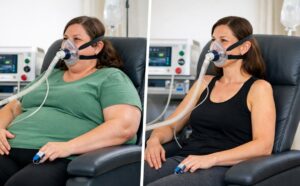
This is where IHHT / IHT (Intermittent Hypoxia Training) becomes relevant.
IHHT / IHT: Autophagy Without Fasting?
Yes.
And this is not marketing—it is biochemistry.
IHT / IHHT leads to:
- AMPK activation
- mTOR modulation
- increased autophagy
- increased mitophagy
- mitochondrial biogenesis
- reduced oxidative stress
- improved energy efficiency
These are exactly the mechanisms that make fasting so powerful.
IHHT / IHT is not a “replacement for fasting”.
It is a second access point to the same repair mode.
Why IHHT / IHT Is Medically Relevant
IHHT / IHT is:
- technically controllable
- clinically dosable
- metabolically precise
- free of dietary stress
- free of compliance barriers
IHHT / IHT is especially suitable for:
- exhausted patients
- older individuals
- people with adrenal dysfunction
- metabolically unstable patients
- patients who are not allowed to fast
Results:
- mitochondria improve significantly
- inflammation decreases
- immune function re-regulates
Conclusion
Autophagy is one of the most important biological repair strategies.
Fasting activates it powerfully.
IHHT activates it via a different, clinically controllable pathway.
Those who want to apply these mechanisms systematically and work with protocols
will find the complete system in the online course by Dr. med. Egor Egorov
(including AMPK, autophagy, mitochondrial and IHHT mechanisms, indication logic, and clinical case examples).
Course link:
https://ecampus.hccacademy.de/s/hccacademy/iht-autophagy-fff2876a
Marion Massafra-Schneider