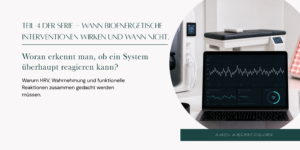
Part 4: When Bioenergetic Interventions Work – and When They Don’t
Why HRV, subjective perception, and functional responses must be evaluated together
In the previous article, we explored a fundamental shift in how bioenergetic interventions should be understood:
The determining factor is not the stimulus itself, but the condition of the system receiving it.
Once this becomes clear, a deeper question inevitably follows:
If the state of the system is so important —
how can it actually be assessed?
This is where the real challenge begins in practice.
The condition of a biological system is not directly visible.
It cannot be reliably reduced to a single marker, a single number, or a single measurement taken in isolation.
And yet, this is precisely what often happens.
A value is measured.
A number appears on a screen.
And that number is interpreted as though it fully reflects the state of the organism.
Biological regulation, however, does not work that way.
The human organism is not a linear machine.
It is a dynamic self-regulating system that continuously adapts to internal and external demands.
For this reason, isolated measurements often fail to capture what matters most: how flexible, adaptive, and resilient a system truly is.
Why HRV Matters — and Why It Is Often Misunderstood
Over the past years, heart rate variability (HRV) has become one of the most widely used markers of autonomic regulation.
This is physiologically reasonable and well supported by research.
HRV reflects the variation in time intervals between heartbeats and is closely linked to autonomic nervous system activity — particularly to the organism’s ability to flexibly shift between activation and recovery.
Research from psychophysiology, neurocardiology, stress medicine, and institutions such as HeartMath has repeatedly demonstrated that higher and more coherent HRV patterns are associated with improved stress resilience, emotional regulation, cognitive performance, and adaptive capacity.
However, an important distinction is often overlooked:
Not every form of variability reflects healthy regulation.
And not every “good” HRV value indicates a stable and resilient system.
A single HRV reading is similar to a photograph.
It captures a moment.
But it does not explain how that moment emerged.
Imagine two people both driving at 60 miles per hour.
One is driving calmly on an empty highway.
The other is navigating through heavy rain and dense traffic at the exact same speed.
The number is identical.
The physiological reality is not.
The same principle applies to isolated physiological markers.
A high HRV value may reflect a well-regulated nervous system that flexibly adapts to stress and reliably returns to baseline.
But it may also represent a compensatory state in which the system is actively attempting to maintain stability despite underlying dysregulation.
Conversely, a low HRV value may indicate impaired regulatory capacity — or simply reflect a temporary period of acute stress or insufficient recovery.
The critical question, therefore, is not:
How high is the value?
But rather:
What does this value reveal about the behavior of the system within its broader context?
From Numbers to Patterns
This is where the difference between data and understanding becomes apparent.
A single measurement reflects a state.
A pattern reflects behavior.
And biological systems are not understood through isolated values — but through patterns over time.
How does the system respond to stress?
How quickly does it recover?
Does it remain stable under changing conditions, or does it become increasingly erratic and inflexible?
One could say:
A snapshot shows a scene.
A movie reveals the story.
This is why trends and patterns often provide far more meaningful insight than isolated data points.
Current research in functional medicine, stress physiology, and neurocardiology increasingly supports the idea that adaptive capacity cannot be defined by rigid numerical thresholds alone, but by the organism’s ability to respond flexibly and recover efficiently.
The Second Layer: What the System Subjectively Communicates
Beyond objective metrics, there is another layer of information that is often underestimated in clinical and performance settings:
subjective perception.
The body continuously communicates.
Not through numbers —
but through sensations and lived experience.
A well-regulated system generally feels regulated.
Energy is available consistently.
Recovery occurs reliably.
Periods of rest actually feel restorative.
A system with impaired regulatory flexibility often presents differently.
The signs are subtle, but remarkably consistent:
Sleep appears sufficient, yet true recovery never occurs.
Energy fluctuates unpredictably.
A persistent sense of internal tension remains, even in objectively calm situations.
Or the individual notices that “switching off” has become difficult — not psychologically, but physiologically.
These observations are not diagnoses in the traditional sense.
But functionally, they are highly relevant.
They often reveal how a system is operating long before conventional pathology becomes obvious.
A useful analogy is that of a musical instrument.
A well-tuned instrument produces clear and stable tones.
An instrument that is slightly out of tune may still play the same melody — but something consistently feels “off.”
Many individuals experience this same subtle physiological dissonance long before standard medical testing becomes abnormal.
The Third Layer: Response to Small Controlled Stimuli
One of the most informative ways to assess a system’s regulatory capacity is to observe how it responds to small, controlled stressors.
Because this reveals not only whether the system reacts — but how it reacts.
A well-regulated system behaves much like an elastic spring.
Pressure is applied.
The spring adapts.
And once the pressure is removed, it returns to its baseline state.
That return to baseline is regulation.
A dysregulated system behaves differently.
The response may become exaggerated, delayed, diffuse, or incomplete.
And here lies an essential distinction:
The most important marker is not the reaction itself.
It is the system’s ability to return to stability afterward.
One could also say:
The wave itself is not the problem.
The problem begins when the water never becomes calm again.
An Integrated Perspective
This is why meaningful assessment can never rely on a single factor alone.
A realistic understanding of system readiness emerges only when multiple layers are considered together:
- objective physiological data over time
- subjective perception and lived experience
- and functional responsiveness to controlled stimuli
Only when these layers are integrated does a clearer picture of true regulatory capacity emerge.
What This Means in Practice
The practical implications are significant.
The goal is not to chase “perfect numbers” or optimize isolated metrics.
The goal is to understand how stable, adaptive, and flexible a system currently is.
Because this ultimately determines whether an intervention is likely to support adaptation — or whether the system first requires stabilization before meaningful adaptation can occur.
Many bioenergetic interventions do not fail because their physiological rationale is incorrect.
They fail because they are introduced to systems that are not yet capable of integrating the stimulus.
If You Want to Explore These Concepts More Deeply
→ HCC Academy – Online Courses & Modules on Bioenergetic Interventions
[SHOP]
For Practical Implementation
I currently work with selected clinics, practitioners, and individuals in both 1:1 and small-group settings, helping them develop a more differentiated understanding of regulatory states and intervention readiness.
The focus is not merely on applying methods, but on understanding when and why a system can meaningfully respond.
→ marion@massafra-schneider.de
And this naturally leads to the next critical question:
Under these conditions, who is actually an appropriate candidate for interventions such as IHHT — and who is not?
That will be the focus of the next article.
Marion Massafra-Schneider
References & Further Reading
- Shaffer F, Ginsberg JP. An Overview of Heart Rate Variability Metrics and Norms. Front Public Health. 2017.
- Thayer JF, Lane RD. The role of vagal function in the risk for cardiovascular disease and mortality. Biol Psychol. 2007.
- McCraty R, Zayas MA. Cardiac coherence, self-regulation, autonomic stability, and psychosocial well-being. Front Psychol. 2014.
- Lehrer PM, Gevirtz R. Heart rate variability biofeedback: how and why does it work? Front Psychol. 2014.
- Porges SW. The Polyvagal Theory. Norton, 2011.
- Kim HG et al. Stress and Heart Rate Variability: A Meta-Analysis and Review of the Literature. Psychiatry Investig. 2018.